


Ernest Tan
If you’ve ever Googled your business and found everything but your website, you’re not alone. In today’s fast-moving digital world, just having a great product or service isn’t quite enough. You also need to show up when customers come looking, or risk being overlooked. That’s where SEO–search engine optimisation–comes in. And no, you don’t need to speak fluent Google or sacrifice your weekends trying to decipher the latest search algorithm updates. You just need a clear, practical SEO strategy tailored to how small businesses operate. In this guide, we’ll walk you through the essentials of SEO marketing for Singapore SMEs–what it is, how it helps your brand grow, and how to do it without blowing your budget or losing sleep. Think of this as your SEO marketing starter kit. Now, let’s get you seen.
Why SEO marketing matters for Singapore SMEs
Let’s face it–whether you’re selling artisanal kaya toast or *ahem* offering award-winning branding and marketing services, someone out there is Googling for it. The question is: will they find you?
That’s where SEO marketing comes in. For small businesses in Singapore, SEO isn’t just about ranking higher on Google–it’s about showing up when your customers are actively looking for what you offer. This visibility builds brand awareness, credibility, generates leads and ultimately drives conversions.
Unlike paid search ads (aka Search Engine Marketing or SEM), which vanish the moment you stop spending, SEO is a long-term play. It improves your online presence steadily and organically, without constant ad spend. And that makes it one of the most cost-effective digital marketing strategies for SMEs looking to grow their audience base and sales without burning through their marketing budget.
Here’s what good SEO marketing can do for your brand:
- Put your business on the map (literally, with local SEO–but we’ll get to that in a bit)
- Build trust with customers who research before they buy
- Make it easier for potential customers to find you amid the online clutter.
- Support your brand storytelling through optimised content
In short, if you’re serious about brand growth, paying attention to SEO is pretty much non-negotiable.
SEM vs SEM: Which is better for SMEs?
Search engine optimisation (SEO) and search engine marketing (SEM) are often mentioned in the same breath when discussing how to boost online visibility.And while they’re related, they’re not the same thing.
SEO focuses on improving your website’s visibility in organic (non-paid) search results. It’s about creating quality content, using the right keywords, and making sure your site is technically sound so that search engines–and your customers–can find you.
SEM, on the other hand, refers to paid search strategies like Google Ads. You’re essentially bidding on keywords to appear at the top of search results, with each click costing you money.
So, which is better? Honestly, it boils down to what you need, how fast you want it and how much you’re willing to spend.
| Cost | Mostly time and effort | Direct monetary spend |
| Speed | Slower to show results (but builds over time) | Almost immediate |
| Longevity | Long-term visibility | Ends when budget runs out |
| Trust factor | Builds credibility with users | Often marked as “Ad” in search |
| Click-through rate (CTR) | Higher for many industries | Lower in some cases |
For SMEs with tight budgets and long-term brand growth goals, SEO often makes more sense as a starting point. In fact, SEO has been shown to drive over 1,000% more traffic than organic social media.
That said, SEM still has its place–especially when you want to:
- Promote a short-term campaign or sale
- Target competitive, high-converting keywords
- Get on page one right now
In most cases, the sweet spot is a mix of both. Use SEM for immediate visibility, and build your SEO marketing strategy in parallel for long-term success.
What is local SEO (and why it’s a good place to start)?
Before diving into any advanced SEO tactics, we’re kicking off with local SEO because, for many Singapore SMEs, capturing “near me” searches yields the biggest impact. Roughly 46% of Google searches are location-based. That means almost half the people Googling right now are looking for businesses near them.

So what’s local SEO, you ask?
Local SEO is the practice of optimising your online presence so you appear for searches with geographic intent–think “bakery in Tiong Bahru” or “accountant near Raffles Place.” If your business serves a specific area (or even all of Singapore), local SEO ensures you show up in those critical moments.
Here’s a concrete example:
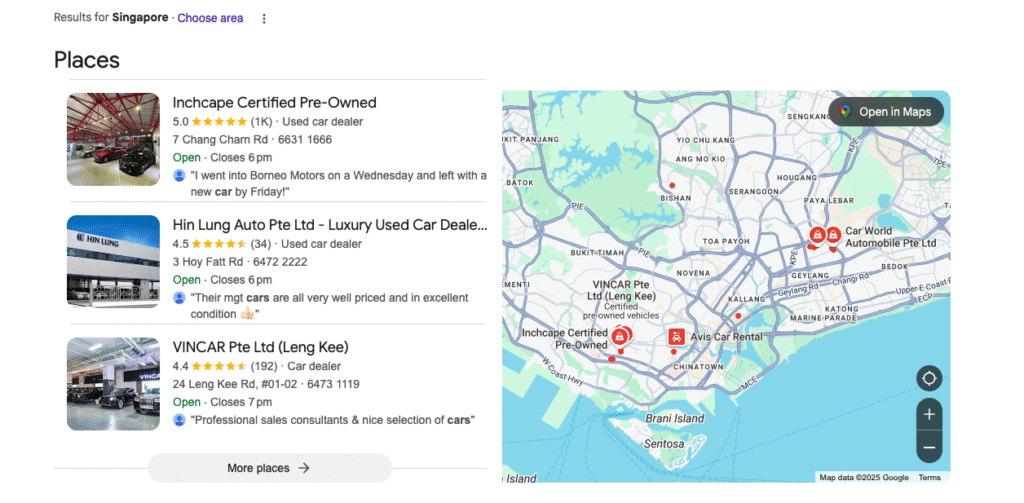
Let’s say someone searches “corporate gift supplier in Toa Payoh.”
If your business serves that area, Google’s local algorithm can pull your listing into the Map Pack–a cluster of three listings that appears above the regular search results. It’s a highly visible spot–so if your business isn’t optimised for local search, you’re missing out.
What does local SEO involve?
Local SEO isn’t just slapping your address on your website. To compete for those “near me” searches, you need to:
- Optimise your google business profile
Claim and complete your profile with accurate details, photos, categories, and business hours. - Use local keywords
Incorporate phrases like “tuition centre in Bukit Timah” into page titles, meta descriptions, and on-page copy. - Earn and Manage Reviews
Encourage satisfied customers to leave reviews–and respond professionally to all feedback. - Build local citations
Get listed in reputable Singapore directories (e.g., Yelp Singapore) and industry-specific sites.
If you’re not optimising for local search, you’re effectively invisible to customers in your own neighbourhood.
How to use local SEO to boost your SME
Now that we’ve covered what local SEO is and why it matters, let’s look at how to actually implement it. If you’re imagining a complicated checklist full of techie jargon and backend wizardry–don’t. Local SEO is surprisingly straightforward once you know what to focus on.
Here’s how you can start building local visibility today–without needing to hire an SEO agency or learn to code:
1. Claim and optimise your Google Business Profile (GBP)
This is non-negotiable. Your Google Business Profile is what shows up in local search results and Google Maps. It’s free, and you can set it up in under 30 minutes.
To optimise it, make sure you:
- Use your real business name (no keyword stuffing)
- Choose the most accurate category (e.g. “physiotherapy clinic” vs just “clinic”)
- Upload high-quality images of your shopfront, products, or office
- Include your hours, website, phone number, and service areas
- Add services and attributes (e.g. “wheelchair accessible,” “LGBTQ+ friendly”)
Set up or manage your Google Business Profile here.
2. Ask for (and respond to) customer reviews
Reviews are gold. Not only do they influence customer decisions, they also send trust signals to Google.
Pro tips:
- Ask happy customers for reviews at the point of service, while the experience is still fresh
- Include a review link in your WhatsApp, email footers or receipts
- Always respond–yes, even to negative reviews. Especially those.
3. Use hyper-local keywords
Target real-world, search-driven phrases like “bridal studio in Outram“ or “best accounting service near Chinatown”. These terms help you rank for intent-driven, high-converting searches.
Bonus tip: Use tools like Google’s Keyword Planner or Ubersuggest to find keywords with actual search volume.
4. List your business in local directories
Local citations (business listings) help Google verify that your business exists, and where it operates.
Start with:
- Yelp Singapore
- Foursquare
- Facebook Business Page
- Any relevant industry-specific directories (e.g. Chope for F&B, HomeTrust for interior design etc.)
Just make sure your NAP (Name, Address, Phone number) is consistent everywhere. Inconsistent information across listings can confuse Google and hurt your chances of appearing in the Map Pack.
5. Create location-specific landing pages (if applicable)
If you have multiple outlets or serve different regions, create pages for each one. For example:
- yoursite.com/tiong-bahru-bakery
- yoursite.com/serangoon-car-rental
This helps you rank in those specific areas and tailor your messaging to local search intent.
Get seen where it counts: In your own neighbourhood
You don’t need to do everything at once. Even just setting up your Google Business Profile, using local keywords, and collecting a few solid reviews can make a measurable difference.
And if you’re already doing some of this? Great. That means you’re closer than you think to turning local searches into real-world sales.
5 budget-friendly SEO tips for SMEs
SEO doesn’t have to cost thousands or come with a steep learning curve. In fact, many of the most effective tactics are low-cost–or even free–if you know where to focus your efforts. Here are five budget-friendly ways to improve your SEO without breaking the bank.
Focus on long-tail keywords
Don’t try to rank for ultra-competitive, broad keywords like “insurance” or “lawyer.” Instead, go niche with long-tail keywords–longer, more specific search phrases, like “freelance insurance consultant for startups Singapore” or “ergonomic office chair with lumbar support Singapore”.
Long-tail keywords are easier to rank for (because fewer businesses use them) and more likely to lead to conversions (because users typically use them when they’re closer to making a purchase decision)
Again, you can use free tools like Google Keyword Planner or AnswerThePublic to find relevant keywords people are searching for.
Pro tip: You can also try paid keyword research tools like SEMrush, which offers a 14-day free trial to go keyword hunting–just remember to unsubscribe before the trial ends to avoid automatic charges.
Optimise existing content first
Before writing anything new, consider optimising your existing website or blog content.
First, use Google Search Console to identify underperforming pages. Look for:
- Pages that are getting impressions (i.e. they’re showing up in search results) but aren’t getting many clicks
- Blog posts that are outdated or thin on useful info
- Service pages that don’t include relevant search terms
Once you find them, try adding clearer headlines, keyword-rich subheadings, and internal links (i.e. links to other relevant pages on your website) to boost their performance.
This is one of the highest ROI moves in SEO, because an existing page already has history, backlinks (i.e., links to your site from other reputable websites), and good potential to rank with a little help.
Start a simple blog (or add new content)
Content is fuel for SEO, and a blog doesn’t have to be fancy to be effective (exhibit A: This blog article). Even one or two posts a month can make a difference–if you’re targeting the right keywords and answering real customer questions.
Having a blog gives you a platform to:
- Target keyword-rich topics
- Answer common customer questions
- Build internal links to your service pages
You don’t need to post daily. Once or twice a month is a good start–as long as it’s relevant, useful, and optimised. Bonus: It gives you content to share on socials and email too.
Get backlinks from partners and directory listings
Backlinks (links to your website from other reputable sites) are a super strong signal to Google that your site is trustworthy–but you don’t need a PR budget to get them.
Start with:
- Local directories
- Trade associations or chambers you belong to
- Vendors, partners or clients you work with (ask them to link you)
- Guest blogging on a relevant site in your niche
Protip: Focus on quality and relevance. A backlink from a respected site is worth more than a dozen from spammy directories.
Improve your website’s user experience
Unfortunately, search engines don’t only care about keywords–they also look at how people interact with your site. If your website is slow, clunky, or confusing, people bounce (i.e. leave your site quickly without interacting)–and your search ranking drops.
Here’s what you can do even with a small budget:
- Compress images using free tools like TinyPNG
- Use headings (H1, H2, H3) to break up walls of text
- Test your site’s speed using PageSpeed Insights
- Make sure your site is mobile-friendly
Clean, fast websites tend to rank–and convert–better.
Pro tip: Some of these improvements may require basic technical know-how. If you’re not confident editing your website yourself, consider engaging a web developer to help with performance optimisations.
Start small. Stay consistent
SEO isn’t magic, and the results aren’t instantaneous. But they are cumulative. Small, consistent actions–done with focus–can snowball into big results over time.
And the best part? You don’t need a big budget. Just a game plan, a few good tools and the willingness to stick with it.
Is paying for SEO services really worth it?
At some point, many SME owners reach a crossroads: Do I keep doing SEO myself–or should I hire someone to do it for me?
Monthly SEO packages are widely offered by freelancers, digital agencies, and SEO specialists in Singapore. But are they worth your money?
Let’s break it down.
Good SEO isn’t just about throwing in keywords. A reputable provider will typically offer:
- Keyword research tailored to your business goals
- Technical SEO (fixing broken links, improving site speed, etc.)
- On-page optimisation (titles, metadata, headings, alt tags)
- Content planning and/or creation
- Backlink building
- Reporting and analytics
- Competitor tracking
All of this takes time, tools, and expertise–so yes, you’re paying for labour, strategy, and access to professional-grade SEO tools.
Protip: Watch out for “guaranteed results” or providers that promise instant rankings. SEO just doesn’t work that way.
What SEO services cost in Singapore
Based on what we’ve seen in the market, here’s a rough guide to what monthly SEO services typically cost in Singapore:
- Freelancers: ~$300–$800/month
Suitable for small businesses with modest goals or limited budgets. - Boutique agencies: ~$800–$2,500/month
Ideal for SMEs looking for more structured SEO strategies, regular reporting, and content support. - Full-service digital agencies: ~$2,000 and up/month
Often includes advanced SEO tactics, integrated content marketing, technical audits, and ongoing competitor analysis.
Please note that these figures are general estimates based on observed market norms. Actual pricing will depend on the provider’s expertise, your business goals, the competitiveness of your industry and the scope of work involved. It’s also worth noting that some providers offer one-time SEO audits or project-based packages–which may be more manageable for SMEs who aren’t ready to commit to a monthly retainer just yet.
So… Is it worth It?
It depends. Ask yourself:
- Do I have the time to do SEO consistently?
- Am I confident interpreting data, optimising content and fixing site issues?
- Is SEO a key channel for my business (e.g. search-driven traffic, local discovery)?
If the answer is no to the above, then outsourcing SEO can be worth it–as long as you choose a reputable partner who sets realistic expectations, communicates clearly, and integrates SEO with your larger brand goals.
Or, if you’re just getting started, you could kick things off by:
- Implementing basic SEO on your own
- Engaging a consultant for a one-time audit and roadmap
- Outsourcing just one part (e.g. technical fixes or keyword research)
If you do choose to outsource, make sure your SEO provider understands your business, communicates clearly, and works in lockstep with your broader marketing strategy–not in a silo. Look for someone who treats SEO as a long-term partnership, not a plug-and-play service.
After all, great SEO doesn’t just improve your search rankings–it builds trust, attracts qualified traffic, and helps your brand grow smarter in a world where visibility is everything.
Get seen, get growing
If there’s one takeaway from all this, it’s that SEO isn’t just for the big guys with deep pockets. When done right, it’s one of the most cost-effective and sustainable ways for Singapore SMEs to grow their visibility, attract the right customers, and strengthen their brand online.
Whether you’re going the DIY route, investing in a freelancer, or considering a more structured SEO plan, the most important thing is to start—and to treat SEO as a long-term game, not a one-time checkbox.
And hey, if it ever starts to feel overwhelming?
Just remember: Even Google didn’t become Google overnight 😉